The Churdhar trek from Nahan was not in the plan. Not even close to the plan. The plan was two nights at The Sirmour Retreat, the terrace, the Shivalik views, the food, and a general agreement between the three of us that this was a rest trip and not an adventure trip and that the distinction mattered.
My friend Rohit had been very clear about this when we booked. He had used the phrase “no physical ambition” at least twice. He had said he wanted to sit somewhere beautiful and do nothing strenuous for forty eight hours.
Rohit is the one who suggested the Churdhar trek.
He suggested it on the first evening at The Sirmour Retreat, approximately four hours after arriving, while sitting on the terrace with the Shivalik range in front of him and a cup of chai in his hand.
The team had mentioned it in passing. The highest peak in the outer Himalayas. Sitting in Sirmour district. Accessible from Nahan with the right planning. Most visitors to this part of Himachal never attempt it.
Rohit put down his chai.
“We are doing that,” he said.
Neither Ankit nor I argued. The hills had already done something to our collective judgment and we had only been here four hours.
What the Churdhar Trek From Nahan Actually Is
Before I tell you what happened on the mountain, let me tell you what the Churdhar trek from Nahan actually involves because the information online is scattered and occasionally contradictory and we spent a confused hour the night before trying to piece it together.
Churdhar Peak sits at approximately 3,647 metres above sea level. It is the highest point in the Shivalik range, which is the outermost and lowest of the Himalayan chains. The trek from Nahan involves driving to the base camp at Nohradhar, about 75 to 80 kilometres from Nahan, and then trekking approximately 14 kilometres to the summit from there.
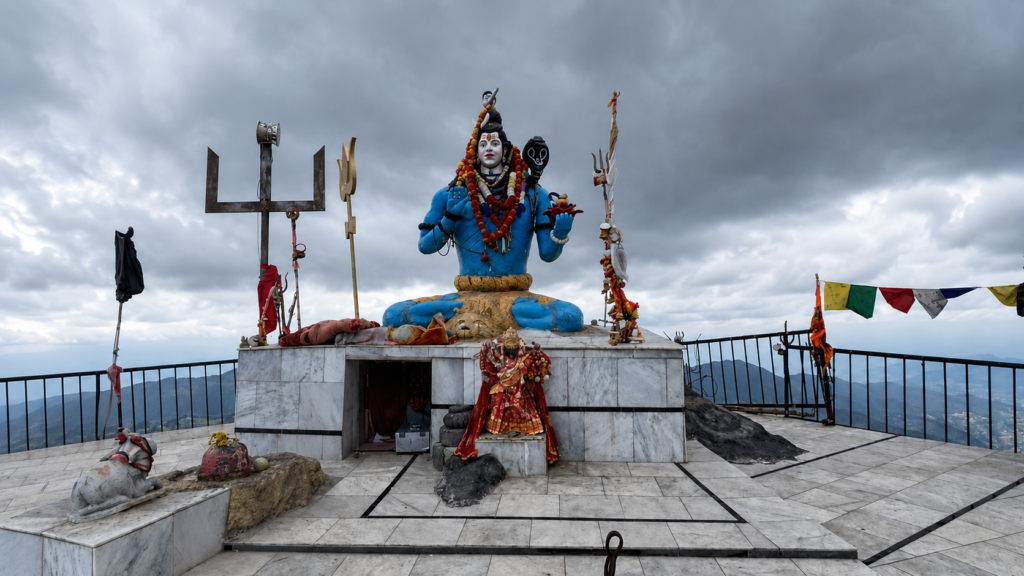
The peak has a temple of Shirgul Maharaj at its summit. The trail passes through dense forests of oak, rhododendron, and deodar before breaking into the alpine zone near the top. On a clear day the views from the summit extend across the plains of North India on one side and deeper into the Himalayas on the other.
The team at The Sirmour Retreat told us all of this the previous evening. They also told us what the online information had not.
Leave by four in the morning. Take the drive to Nohradhar seriously. Start the trek early enough to summit before noon and descend before the afternoon clouds arrive. Carry water for more than you think you will need. The first three kilometres are deceptive. After that the trail stops pretending.
That last sentence should have given us more pause than it did.
The Morning That Started Before Dawn
We left The Sirmour Retreat at four fifteen in the morning.
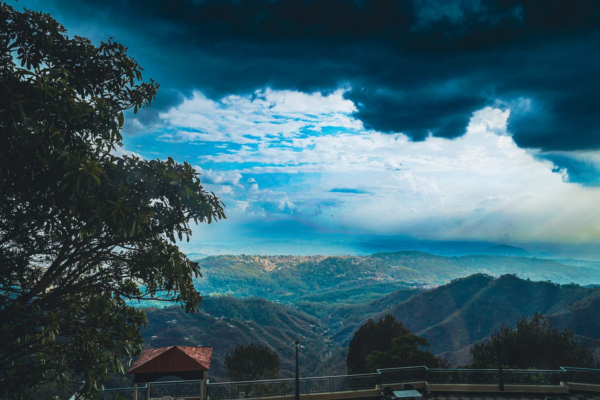
The property was completely still. The valley below was invisible in the dark. The Shivalik hills were silhouettes against a sky that had not yet decided to become morning.
Ankit drove. Rohit sat in the front and navigated. I sat in the back with my forehead against the cold glass and watched the darkness outside change texture as we climbed.
The drive to Nohradhar from Nahan takes about two hours on roads that are perfectly serviceable and occasionally interesting in the specific way that mountain roads are interesting at four in the morning when you are the only vehicle on them for long stretches.
We arrived at Nohradhar just before six thirty.
The sky was doing something extraordinary. That specific pre-sunrise quality where the darkness has already given up but the light has not yet fully arrived and everything exists in a blue grey that has no real equivalent outside of high altitude mornings.
We stood in the car park for a moment.
Rohit said: “Okay. This was a good idea.”
Ankit said: “Ask me again in five kilometres.”
What the First Section of the Churdhar Trek From Nahan Teaches You
The trail begins in forest.
Dense, close, deodar and oak coming in from both sides with the kind of consistency that makes you understand what a forest actually is rather than what a city person usually means by the word.
The first three kilometres are what the team at The Sirmour Retreat had called deceptive. They are not flat. But they are gradual. The kind of gradient that feels manageable and keeps feeling manageable until you realise you have been climbing for ninety minutes and the air is already different and your legs have started a conversation with you that they are going to continue for the rest of the day.
Rohit, who had declared no physical ambition forty eight hours earlier, was two steps ahead of both of us and showing no signs of slowing down. This is the thing about certain people and certain mountains. The mountain finds something in them that the daily pace keeps buried.
We stopped at a small clearing about forty minutes in where the trees opened enough to show us what was behind us.
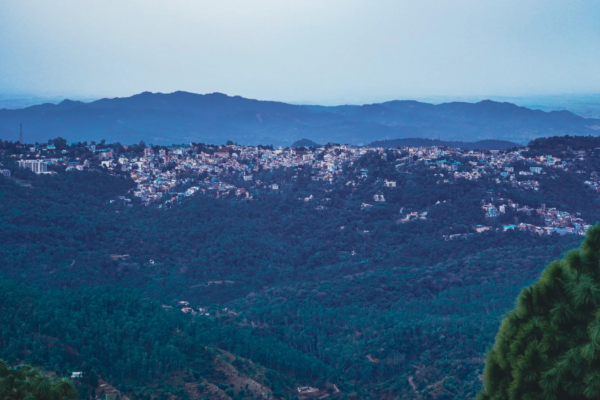
The plains of North India, spread out below and behind, already visible and golden in the first proper light of the morning.
None of us said anything for a while.
Then Ankit said: “I see why people do this.”
The Forest That Keeps Changing
One of the things nobody had told us about the Churdhar trek from Nahan was how much the character of the forest changes as you climb.
The lower section is deodar and oak, cool and enclosed, the light coming through in the filtered way that forest light does when the canopy is dense. The smell is of wet earth and pine and something slightly sweet that I could not identify and did not try too hard to name.
Higher up the rhododendron comes in. In the right season the flowering rhododendron at altitude in this part of Himachal is something that photographers spend their careers trying to capture adequately and mostly do not. We were there after the peak flowering but there was still enough colour in the trees to make the upper forest feel like a different place from the lower one.
Higher still the trees thin and then stop and the alpine zone arrives and suddenly there is nothing between you and the sky except altitude.
That transition is the moment the Churdhar trek from Nahan announces what it actually is.
Not a forest walk. Not a hill climb in the mild sense that Chandigarh weekend trekkers usually mean. A serious mountain that has been quietly building its case across every previous kilometre and reveals it fully only when it is too late to reconsider.
Rohit stopped at the treeline and looked up.
He did not say anything.
The summit was visible from there, further than it looked and higher than the photographs had suggested, with the temple at the top visible as a small dark shape against the sky.
What the Summit of Churdhar Gives You
We reached the top in just over five hours from Nohradhar.
I am not going to pretend the last two kilometres were enjoyable in any conventional sense. The altitude was doing things to the available oxygen that my lungs had opinions about. The trail was steep enough that walking required active decisions about where each foot was going. Ankit had stopped making jokes somewhere around kilometre ten and was simply moving with the focused silence of someone who has decided that speaking is an inefficient use of available resources.
Rohit was still two steps ahead.
The temple of Shirgul Maharaj at the summit is not a large structure. It is the kind of building that the mountain itself seems to have permitted rather than one that was imposed upon the landscape. Small, old, attended by a priest who had climbed the same trail we had climbed and who receives visitors at the top of the highest peak in the outer Himalayas with the calm of someone who does this every day.
Because he does.
We sat near the temple for almost an hour.
The view from Churdhar summit on a clear day is a geography lesson delivered from the best possible position. The plains of North India spread out to one side all the way to a horizon so distant it is difficult to process. The deeper Himalayan ranges visible to the other side, range behind range, each one higher than the last, the whole thing receding into a blue distance that makes you understand viscerally why people have been trying to paint this part of the world for centuries and have mostly failed to do it adequately.
Ankit, who had been silent for two kilometres, looked out at the plains below and said: “You can see everything.”
He was being precise.
You can see everything from up there. Not just geographically.
“The Churdhar trek from Nahan is the thing The Sirmour Retreat mentioned and we almost did not do. Rohit pushed for it and Ankit and I followed and standing on that summit looking at the plains of North India spread out below us, I understood something about why people climb mountains that no amount of reading had managed to teach me before. The Sirmour Retreat was the right place to leave from and the right place to come back to. Both halves of the day needed each other.”
Vikram, guest at The Sirmour Retreat, Nahan
The Descent and What It Did to Us
We started down at eleven thirty.
The team at The Sirmour Retreat had said to be off the summit by noon and they had said it with the specific certainty of people who know what the afternoon clouds do to this mountain and do not want you to find out personally.
The descent took three and a half hours.
Descents are a different experience from ascents in ways that are difficult to explain to someone who has not done a long mountain day. The views are the same views but from a different angle. The legs are involved in a completely different kind of work. The mind, which on the way up is occupied with the effort of climbing, is on the way down left to do whatever it wants.
What my mind did on the way down was process the morning in the way that minds process things they have not encountered before. Not thoughts exactly. More like a slow rearranging of the furniture of how I think about certain things.
Rohit talked almost continuously on the descent. This is his processing method. He talked about his father who had always wanted to do a serious trek and had not got around to it. He talked about a version of himself from five years ago who would not have suggested the Churdhar trek from Nahan on the first evening of a rest trip. He talked about what it meant that the version of himself that had done this was the one who had arrived at The Sirmour Retreat the previous afternoon.
Neither Ankit nor I interrupted him.
Some things want to be said out loud in descent.
Returning to The Sirmour Retreat
We got back to Nohradhar at three in the afternoon. Sat in the car for a few minutes before anyone could make a decision about driving.
The drive back to Nahan took two hours. Ankit drove this time. Rohit and I sat in the back and said almost nothing.
We arrived at The Sirmour Retreat as the sun was going behind the Shivaliks.
The team had dinner ready earlier than usual because they had known, from the time we had left and the condition in which serious mountain days return people, that we were going to need it.
We ate on the terrace. The valley below doing its usual evening thing. The hills catching the last light.
Nobody spoke much over dinner. The mountain had used up our words and the terrace was using up what was left of our attention and together they produced the best silence of the entire trip.
At some point Rohit put down his fork and looked at the hills and said: “We nearly didn’t do it.”
He meant the trek. He meant the entire thing from the moment on the first evening when the team had mentioned it to the moment on the summit when we had stood and looked at everything.
We nearly did not do it.
I am still grateful we did.
What You Should Know Before You Go
The Churdhar trek from Nahan requires a full day. Not a half day. Not something you can attach to a regular sightseeing schedule. A full day, starting before sunrise, with nothing else planned before or after it.
Nohradhar is approximately 75 to 80 kilometres from Nahan. Allow two to two and a half hours for the drive each way. Leave The Sirmour Retreat no later than four thirty in the morning to reach Nohradhar by six thirty and start the trek with enough daylight ahead of you.
The trek from Nohradhar to the summit is approximately 14 kilometres one way. A reasonable pace for people in moderate fitness is five to six hours up and three to four hours down. Start descending by eleven thirty at the latest. The afternoon clouds on this mountain are not a suggestion.
Carry more water than you think you need. The trail has limited water sources in the upper sections and altitude does things to your thirst calculation that you cannot fully compensate for until you have experienced it.
Good trekking shoes are not optional. The trail is well defined but the upper section involves loose ground and steeper gradients that reward proper footwear and punish the alternative.
Tell the team at The Sirmour Retreat you are planning this trek the evening before. They will give you information that is more practically useful than anything available online and they will have food ready for you when you return, which at the end of a Churdhar day is the most generous thing anyone can offer.
The best months are April through June and September through November. Avoid July and August when the trail becomes slippery and the visibility unpredictable. Avoid December through March when the upper sections are under significant snow unless you have the equipment and experience for winter alpine trekking.
The Thing About This Trek and This Property
The Churdhar trek from Nahan works as well as it does partly because of where you are returning to.
A long mountain day returns you in a specific state. Not just physically tired. Emptied in a deeper way. The kind of state that needs a particular quality of place to receive it properly.
The Sirmour Retreat receives it perfectly.
The terrace at the end of a Churdhar day, with the valley below going dark and the same Shivalik range that you climbed visible from a completely different angle and perspective, produces something that neither the trek alone nor the property alone could quite achieve.
They work together.
The mountain takes something. The terrace gives it back in a different form. Together they produce a day that you will still be thinking about weeks later when you are back inside ordinary life and you close your eyes and you are on that summit again looking at everything.
That is the Churdhar trek from Nahan.
Most travellers never attempt it.
Most of them do not know they are missing something that does not have a replacement.
Now you know.