Nobody had given us a proper list of things to do in Nahan before we arrived.
The internet had tried. We had found the usual results. Renuka Ji Lake. The town market. A mention of some viewpoints without specific directions. The kind of travel content that tells you a place exists without telling you what to do inside it.
My husband Vikrant had printed three different articles before we left Delhi. We read all three on the drive up. By the time we reached Ambala none of us had a plan that felt specific enough to be useful.
Then we arrived at The Sirmour Retreat.
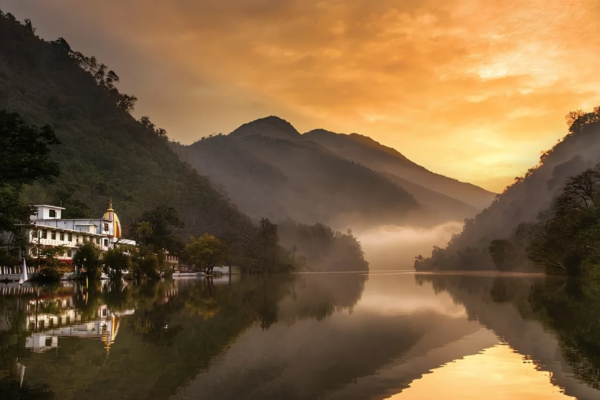
And on the first evening, over chai on the terrace with the Shivalik range doing extraordinary things with the last of the light, one of the team members sat down with us and spent forty minutes telling us what Nahan actually contains.
It was the most useful forty minutes of the entire trip.
This blog is that conversation, written down for everyone who arrives in Nahan without it.
Why the Usual List of Things to Do in Nahan Misses the Point
The standard travel content about Nahan covers the obvious.
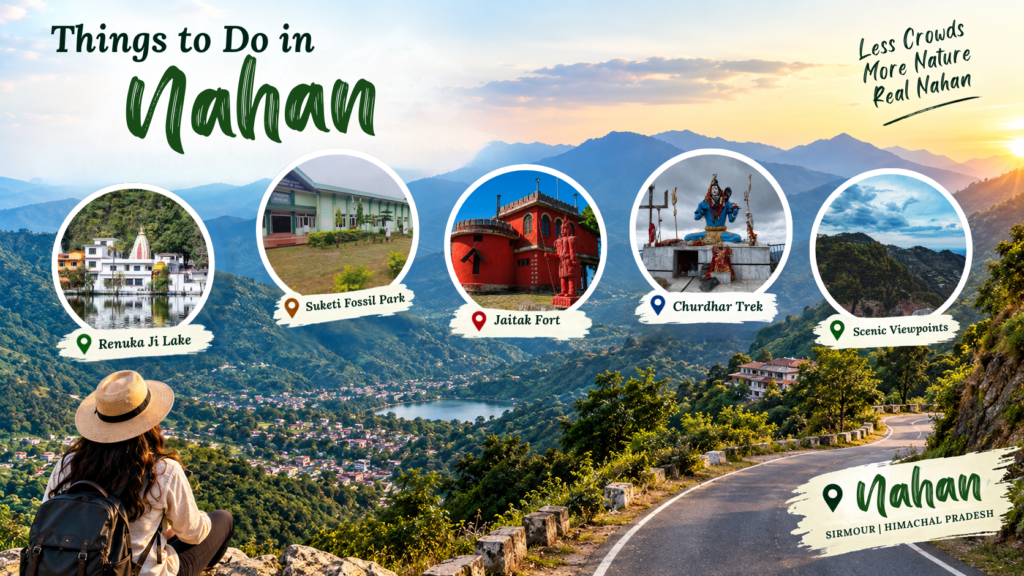
Renuka Ji Lake. Suketi Fossil Park. The town market. These are real and worth your time and I will come to all of them. But they are the surface of what Nahan contains and most visitors leave having only scratched it.
The reason is simple. Nahan has not been written about enough. The content that exists was produced by people who spent a day there and covered what was easiest to find. The things that make Nahan genuinely worth staying for, the specific corners and timings and local knowledge that separate a good trip from one you keep thinking about, are not in any article.
They are in the memory of the people who live there. And in the knowledge of the team at The Sirmour Retreat, who have been watching guests discover them for long enough to know exactly what order to suggest them in.
What follows is what they told us. Starting with the thing they mentioned first.
Things to Do in Nahan: Start With the Town Before You Do Anything Else
The most important thing to do in Nahan is also the one most visitors skip entirely.
Walk the old town.
Not drive through it on the way to a viewpoint. Walk it. Slowly. Without a destination or a timeline.
Nahan is one of the oldest planned hill towns in Himachal Pradesh. The town was established in 1621 by Raja Karan Prakash and the original layout, the central chowk, the lanes radiating outward, the architecture that has been added to over four centuries without ever quite losing the original logic, is still legible if you walk it with enough attention.
We went on the second morning, before breakfast, while the town was still in its early state. Shopkeepers setting up. Tea stalls producing the first chai of the day. A pace that the afternoon crowds would later change but that at seven in the morning was entirely itself.
The central market area has a temple at one end that most people photograph from the street. Go inside. The courtyard has a quality of early morning stillness that the street does not prepare you for.
We spent two hours in the town and came back to The Sirmour Retreat for breakfast having understood where we were in a way that the previous day of viewing it from the terrace had not provided.
The team had said: know the town first. Everything else in Nahan makes more sense after you do.
They were right.
Renuka Ji Lake: The Thing to Do in Nahan Nobody Plans Enough Time For
Most visitors to Nahan treat Renuka Ji Lake as a two hour stop.
It requires a full day.
Not because the site is enormous. Because it rewards time in a way that passing through it does not allow. The lake, the adjacent Parshuram Tal, the temple, the wildlife sanctuary that surrounds it, the forest that starts where the sanctuary ends: these are not separate items on a checklist. They are parts of a single experience that only assembles itself if you stay long enough for each part to connect to the next.
Renuka Ji Lake in Nahan is the largest natural lake in Himachal Pradesh. The shape of the lake is said in local mythology to be the outline of Goddess Renuka herself. Whether you arrive with that context or encounter it on site, it changes how you look at the water.
We arrived at ten in the morning. We left at three thirty in the afternoon.
We had planned to leave at noon.
The morning at the lake has a quality that the afternoon does not. The mist is still clearing. The forest is active in ways it stops being once the day heats up. The langurs in the sanctuary trees are visible and unbothered by visitors at that hour in a way they are not later.
My wife Shreya spent an hour near Parshuram Tal, the smaller lake adjacent to the main one, sitting on a stone near the water doing nothing in particular. She is not a person who sits still for an hour doing nothing in particular. The place created the conditions for it without asking.
The dhaba near the entrance is worth stopping at before you leave. Simple food. Local preparation. Dal that costs almost nothing and tastes like someone made it that morning with full attention. We ate there at two in the afternoon and have both mentioned it multiple times since coming home.
Suketi Fossil Park: The Most Underrated Thing to Do in Nahan
Nobody had mentioned Suketi Fossil Park to us before the team at The Sirmour Retreat brought it up on the first evening.
This is a significant oversight on the part of travel content about Nahan.
Suketi Fossil Park is one of the most important prehistoric fossil sites in Asia. The Shivalik hills in this region contain some of the richest fossil deposits in the world, and the park was established to display life size reconstructions of the animals whose remains were found here. Sivatherium, a prehistoric giraffe that stood almost three metres tall. Stegodon, an extinct relative of the elephant. Hippopotamus sivalensis, which existed in this part of the subcontinent long before anyone was counting things.
These animals were real. They lived here. In the hills you can see from The Sirmour Retreat terrace.
That fact does something to how you look at the landscape for the rest of the trip.
My husband Vikrant is a history teacher. He stood in front of the Sivatherium model for almost twenty minutes. He came back to where I was standing with the expression of someone who has just recalibrated something.
“This is one of the most significant sites I have ever been to,” he said. “And I have never heard anyone mention it.”
That is Suketi Fossil Park. Come prepared for it to be more than you expected and give it more time than the entrance suggests it needs.
Jaitak Fort: The Hidden Thing to Do in Nahan With the Best View
Most visitors to Nahan never find Jaitak Fort.
Not because it is difficult to reach. Because it is not on any of the lists.
Jaitak Fort sits in the hills above Nahan and is most significantly associated with the Anglo-Nepalese War of 1814 to 1816. The Gurkha commander Ranjor Singh Thapa held this fort against British forces with a tenacity that became one of the most documented episodes of that campaign. The fort changed hands multiple times. The hills around Nahan during that period were contested in ways that the quiet town below gives no indication of.
Standing inside the fort and knowing this changes what you see.
The view from the upper walls covers the plains of North India in one direction and the deeper Shivalik range in the other. From this position the strategic logic of the fort is immediately apparent. You understand why people fought for it. You understand what it meant to hold it.
The trail from the drop off point takes about forty minutes at a comfortable pace. Wear shoes you trust on uneven ground. Go in the morning when the light is right and the heat has not yet arrived.
Tell the team at The Sirmour Retreat you want to visit Jaitak Fort and get the history briefing before you go. Arriving with the context is the difference between seeing old walls and understanding what they held.
The Churdhar Trek: For the Things to Do in Nahan That Challenge You
Churdhar Peak is the highest point in the outer Himalayas.
It sits in Sirmour district. It is accessible from Nahan. And it is the thing to do in Nahan that most visitors never attempt because they do not know it is possible from here.
The trek begins at Nohradhar, about 75 to 80 kilometres from Nahan, and covers approximately 14 kilometres to the summit at 3,647 metres above sea level. There is a temple of Shirgul Maharaj at the top. On a clear day the view from the summit shows the plains of North India on one side and the deeper Himalayan ranges on the other.
This is a full day commitment. Leave The Sirmour Retreat by four thirty in the morning. Start the trek at Nohradhar by six thirty. Summit by noon. Descend by four in the afternoon.
It is worth every hour of it.
My husband attempted it on our third day while I spent the morning in Nahan town and at the terrace. He came back in the early evening changed in a way that a day at a resort does not produce and a mountain does.
He sat on the terrace with a cup of chai and looked at the Shivaliks for a long time.
Then he said: “You should have come.”
I am going on the next trip.
The Morning at The Sirmour Retreat Terrace: The Thing Nobody Lists
This is not on any official list of things to do in Nahan.
It should be.
Waking up early and sitting on the terrace at The Sirmour Retreat before the valley below has fully assembled itself is one of the more valuable things available in this part of Himachal Pradesh.
The mist at that hour is different from the mist you see in photographs. It moves. It has texture. The valley disappears into it and then reappears and then disappears again and the hills above it are doing something with the first light that has no adequate equivalent in any photograph I have seen of it.
Chai arrives without being asked for.
That detail matters more than it should. It is the small thing that tells you everything about how the place operates and what it believes its job actually is.
Sit there for an hour. Do not plan anything for that hour. Let it be the first thing you do in Nahan before any other item on any list.
It organises everything that follows in a way that is difficult to explain until you have experienced it.
“Things to do in Nahan go much further than most people realise before they arrive. The Sirmour Retreat gave us a list on the first evening that took us three days to work through and we still had things left when we checked out. Nahan is not a one day town. It is a place that keeps revealing itself if you give it enough time and the right starting point.”
Shreya, guest at The Sirmour Retreat, Nahan
The Nahan Heritage Walk: Things to Do in Nahan for History Lovers
The team at The Sirmour Retreat suggested a heritage walk through Nahan on our last morning.
We had already been into the town twice. We thought we had seen what it contained.
We had not seen what it contained.
A heritage walk through Nahan covers things that a casual walk through the market does not reach. The older sections of the town where the architecture still carries the Sirmour royal period in its proportions and materials. A small temple near the older residential area that has been continuously attended for centuries and that most visitors drive past without noticing. The elevated section of the town where the original planning logic is most visible and where the view back over the market area reveals the structure of the town in a way that ground level walking does not.
Give it two hours. Go with someone who knows it. The team at The Sirmour Retreat can point you toward the right guide or give you enough context to find the most significant sections on your own.
History of a place is the difference between passing through it and actually visiting it.
Nahan has considerable history. Most visitors leave without knowing it was there.
What to Do With Your Evenings in Nahan
The evenings in Nahan have a quality that deserves its own mention because they are different from the evenings in every hill station we had visited before.
The Sirmour Retreat terrace at dusk is where the day ends properly.
The valley below goes through a sequence of colours as the sun drops behind the Shivaliks that no forecast or photograph accurately predicts. Gold first. Then amber. Then a specific shade of orange that lasts about eight minutes and then is gone. Then the blue of early evening. Then dark and the lights of Nahan town appearing below one by one.
This sequence happens every day. It is worth watching every evening you are there.
We ate dinner on the terrace on both evenings. The Himachali food deserves a separate blog and has received one elsewhere on this site. What I want to say here is that eating on that terrace in the evening is one of the things to do in Nahan that requires no planning, no directions, no historical context, and no early morning alarm.
Just sit there. Let the hills do what they do.
That alone makes the drive from Delhi worth it.
Practical Notes Before You Plan Your Nahan Trip
Nahan is 290 kilometres from Delhi and about 100 kilometres from Chandigarh. Five to six hours by road from Delhi. Under two hours from Chandigarh.
The best months to experience things to do in Nahan are March through June and September through November. October is particularly good for Renuka Ji Lake and the Churdhar trek. March and April are best for the Shivalik green and the spring light that makes every outdoor activity more photogenic than it deserves.
Stay at The Sirmour Retreat for at least two nights. One night is enough to see the terrace. Two nights is enough to actually do Nahan.
Talk to the team on the first evening. The conversation we had over chai on our first night organised the entire trip in a way that no article, including this one, fully replaces. They know what the place contains and what order it should be experienced in and how much time each thing actually needs as opposed to how much time most people give it.
Three days is the minimum if you want to attempt both Renuka Ji Lake and the Churdhar trek alongside the town. Four is more comfortable.
Come without a fixed itinerary. The best things to do in Nahan are the ones you find when the team tells you something on the terrace that was not in any article you read before arriving.
That is still where the best information lives.